Start with what the learner shows
Use readiness, prior knowledge, and response evidence to identify a need.

Teacher certification · Digital study guide
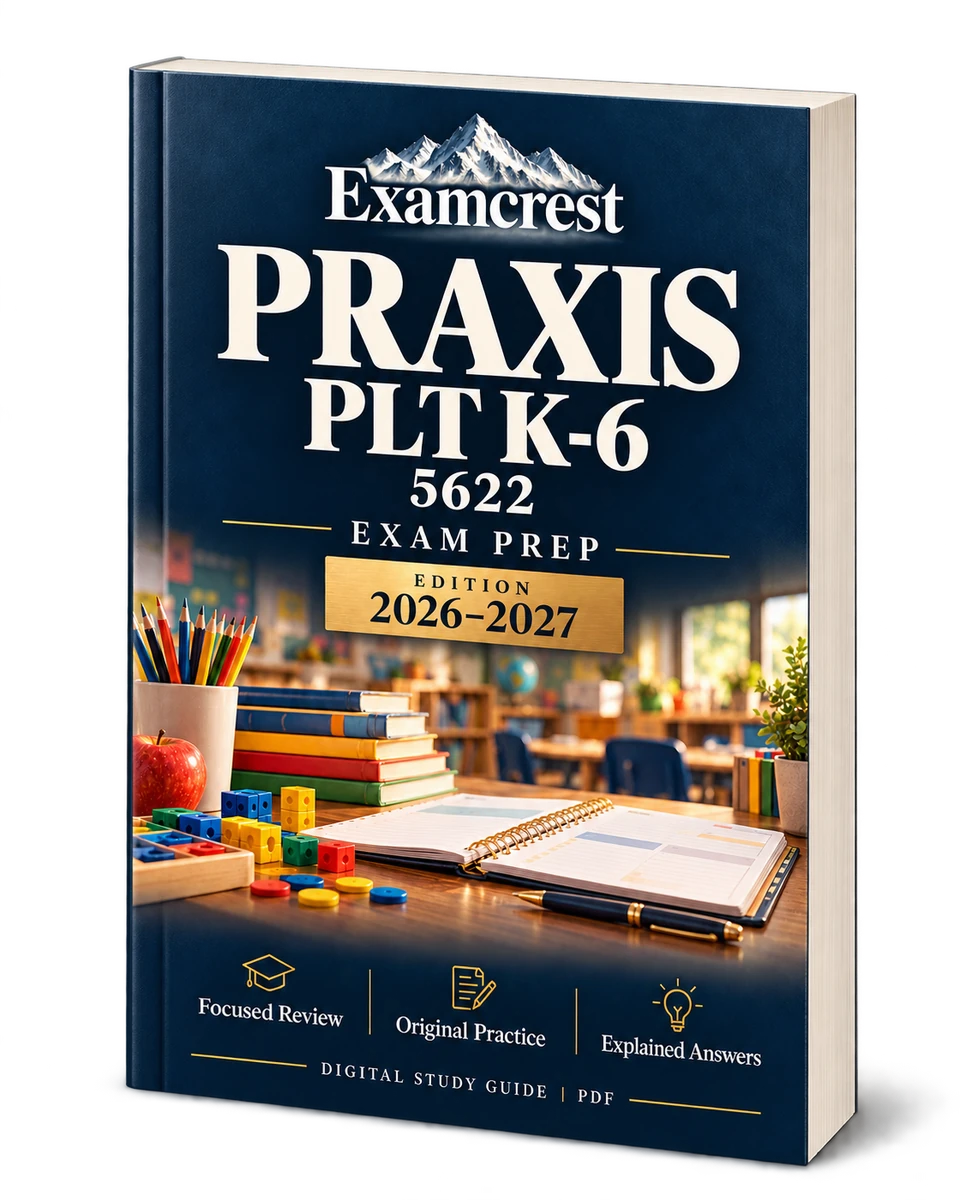
Praxis PLT K–6 5622 Study Guide
Connect classroom observations with learning, instruction, assessment, and professional judgment through original practice and case-based writing.
Focused study and practice. Check the coverage before you choose.

Study with a clear purpose
Use readiness, prior knowledge, and response evidence to identify a need.
Connect the objective, activity, and assessment of understanding.
Practice discussing accessibility, collaboration, and responsible classroom decisions.
Your guide, at a glance
180 pages of foundation review, worked reasoning and explained practice in one downloadable PDF. 160 bank activities plus 75 lesson activities across 15 progressive units. Includes a two-page illustrated visual lesson.
Development, learning processes, motivation, language, and individual needs.
Objectives, sequencing, modeling, differentiation, feedback, and technology.
Purpose, evidence, validity, reliability, numerical interpretation, and accessibility.
Ethics, records, collaboration, reflection, and learning environments.
Worked case analyses and additional shared case histories with writing tasks.
Explore two real pages from your guide
Included in your guide · PLT-U12 · PDF pages 179–180
PLT-U12 / Visual concept

A score, a percentage and a percentile carry different meanings.
A fictional classroom report gives 18 of 25 points, a supplied scale of 300 + 4 × raw points, and the 65th percentile. Its convention places 65% of the reference group at or below the score.
PLT-U12 / Worked case

Raw score is 18 of 25; percent correct is 18/25 × 100 = 72%. The denominator is available task points.
Scaled score = 300 + 4 × 18 = 372. Reverse-check: (372 - 300)/4 = 18. The scaled value is not a percentage.
The 65th percentile describes position in the stated group. It is not 65% correct or 65% of the curriculum mastered.
No. Inspect errors against learning criteria. A gap may concern fraction magnitude, reading access or a calculation slip.
The transformation and norm are fictional, with no official exam equivalence. Another reference distribution can give a different percentile for the same 72%.
A practical study routine
Use the guide actively: make a decision before checking the answer, then bring the lesson into your next attempt.
Step 1
State what the pupil’s work actually shows.
Step 2
Choose an action that addresses the observed need and objective.
Step 3
Use the worked cases and writing tasks to make the follow-up evidence explicit.
Teacher candidates preparing specifically for Praxis Principles of Learning and Teaching: Grades K–6, test 5622.
The purchase includes this PDF edition. It does not include video lessons, tutoring, exam registration, or a promise of future updates. No exam result is guaranteed.
The assessment-access comparison makes the learning target matter. An oral explanation and independent writing can measure different things, so the example gives a useful reason to check a support against the particular classroom task. The comparison makes the support decision easier to explain, without assuming that the same adjustment measures the same skill in every situation.
The fraction example follows learning beyond the supplied bars. I like that it fades the support and checks a new comparison, instead of treating success with help as proof of independent understanding.
The exact-wording rubric makes reliability and validity easy to separate. Two scorers can agree while the task still misses the intended mathematical understanding; the example gives that distinction a concrete classroom meaning.
The fictional report works through the different score types rather than treating them as interchangeable. I had to compare the definitions carefully, but the calculations explain why percent correct and percentile answer different questions.
The annotated response turns the identified misunderstanding into targeted teaching and a fresh check. I like that it distinguishes a group's preference from evidence of feasibility, so the written answer has a practical next step.
Before you decide
Choose the format and coverage that fit your study plan.
This is one English-language PDF download. No physical book is shipped. The page and practice counts shown above refer to the PDF included with this product.
The complete practice bank contains 160 numbered learning activities. Questions and teaching drills are counted as activities, not as full-length exams. The progressive lesson activities are separate from this bank count.
The product is delivered as a digital download associated with your order. Keep your order confirmation. If you have trouble locating or opening your file, contact ExamCrest with your order number.
Yes, with a compatible PDF reader. Save the file for offline reading. The book uses fixed pages, so smaller screens may require zooming; the sample pages show the layout before purchase.
The PDF supports printing. Choose the pages you need and check the scale and margins in your PDF reader. Printing costs and printer supplies are not included.
160 bank activities plus four supplementary writing tasks based on two shared case histories. Ordering and multiple-selection drills support learning; the bank is not a full-length 5622 form. The four worked case analyses are examples, not extra scored bank questions. No passing result or score increase is guaranteed.
For download help or refund questions, contact ExamCrest using the support link below. Include the product name and, if you have purchased, your order number. Confirm any refund terms before ordering; no satisfaction-guarantee period is promised on this page.
Praxis PLT K–6 5622 Study Guide
180 PDF pages · 160 complete bank activities · Answer explanations
One digital PDF. The contents and scope are shown above.