Locate the responsibility
Separate switching, routing, name resolution, transport, and application behavior.

Networking · Digital study guide
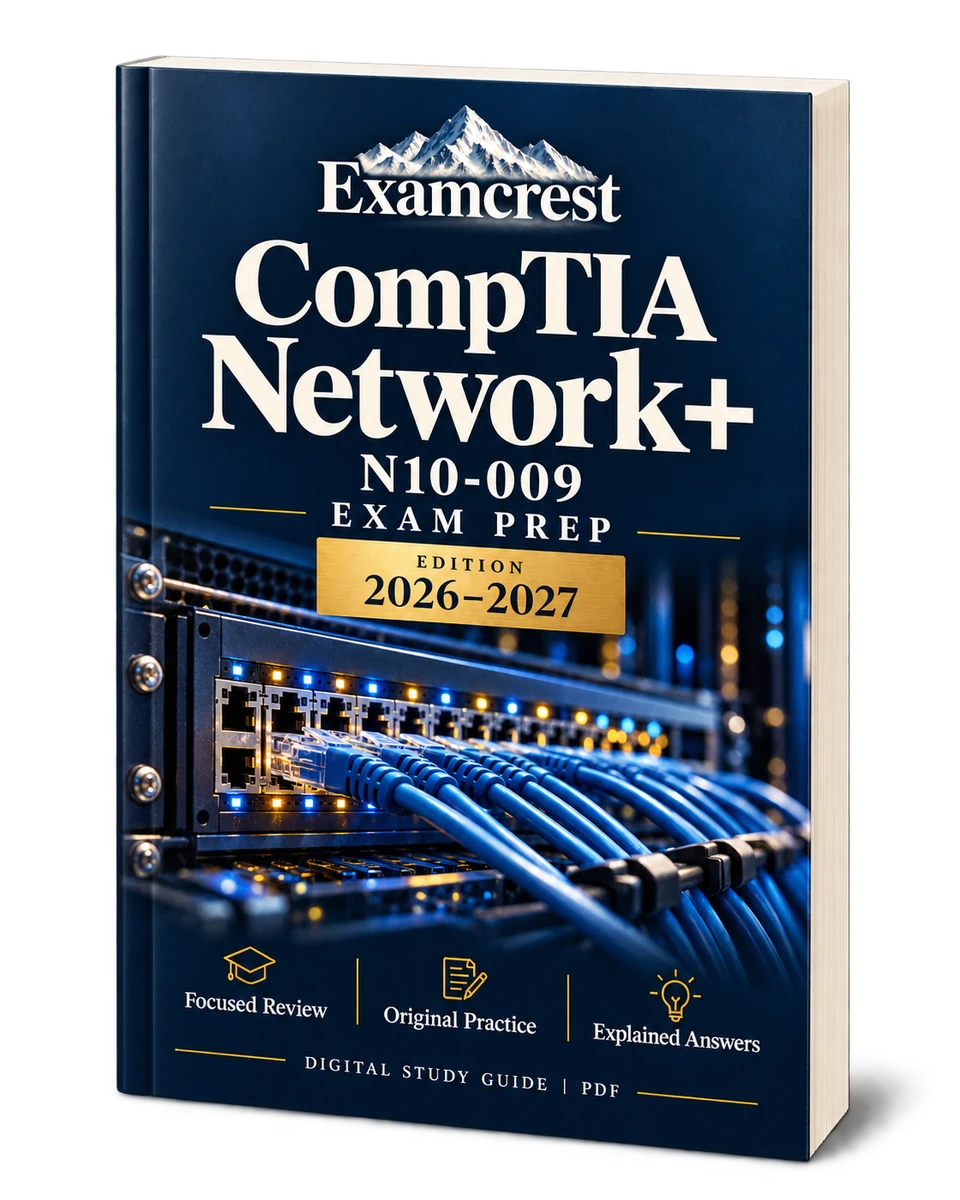
CompTIA Network+ N10-009 Study Guide
Build a more systematic way to read network problems with selected-topic instruction, original scenarios, and detailed explanations.
Focused study and practice. Check the coverage before you choose.

Study with a clear purpose
Separate switching, routing, name resolution, transport, and application behavior.
Choose checks that can disprove a hypothesis instead of making untested changes.
Read trust boundaries, monitoring, recovery, and change control together.
Your guide, at a glance
199 pages of foundation review, worked reasoning and explained practice in one downloadable PDF. 140 bank activities plus 135 lesson activities across 27 progressive units. Includes a two-page illustrated visual lesson.
Layers, addressing, subnetting, routing, services, and architecture.
Media, transceivers, power, wireless, and physical dependencies.
Documentation, monitoring, change management, and continuity.
Trust boundaries, secure management, hypotheses, and worked investigations.
Explore two real pages from your guide
Included in your guide · NET-U10 · PDF pages 198–199
NET-U10 / Visual concept

The prefix decides membership, not the distance between addresses.
The source is 10.20.30.62/27 and the destination is 10.20.30.65. Their last octets differ by only 3. Does that put them in the same subnet?
NET-U10 / Worked case

A /27 has 32 addresses. The source belongs to 10.20.30.32/27: network .32, broadcast .63, ordinary hosts .33 through .62.
Destination .65 belongs to 10.20.30.64/27. It is off-subnet under this mask; matching the first three octets is not enough.
Communication needs an appropriate routed path and policy. Address arithmetic verifies membership, not physical connectivity or a working configuration.
No. With /26, .62 belongs to the .0/26 block and .65 to .64/26. Recompute the prefix instead of assuming a larger block crosses this boundary.
In these ordinary IPv4 examples, network and broadcast addresses are reserved. A target .63 is the source subnet’s broadcast address, not an ordinary host.
A practical study routine
Use the guide actively: make a decision before checking the answer, then bring the lesson into your next attempt.
Step 1
Identify endpoints, address configuration, and the service involved.
Step 2
Choose a check whose result would distinguish plausible causes.
Step 3
Review the explanation and the evidence needed after a change.
Network+ N10-009 learners who want reasoning practice alongside hands-on networking and the official objectives.
The purchase includes this PDF edition. It does not include video lessons, tutoring, exam registration, or a promise of future updates. No exam result is guaranteed.
The subnet example works through the usable range and broadcast address before checking the gateway. I like that a nearby-looking address still has to pass the actual membership check, rather than being accepted by appearance. The worked range makes the reason for rejecting the other candidate easy to check without relying on how close the addresses look.
The relay example follows the client request through the broadcast and routed paths. The logs give the next check a reason, which is much more useful than choosing a fix from a list of possibilities.
The tunnel example keeps the size calculation visible and explains the direction of MSS. Having the arithmetic beside that detail makes it easier to see which part of the exchange the limit applies to.
The CRC trials need a close look at the table. Changing the port, channel or endpoint tests different ideas, and I like that the explanation keeps an interaction separate from proof of one universally bad component.
The local HTTP example treats resolution, connection and the requested path as separate checks. An error response still tells you something useful, instead of being treated as evidence that every network stage failed.
Before you decide
Choose the format and coverage that fit your study plan.
This is one English-language PDF download. No physical book is shipped. The page and practice counts shown above refer to the PDF included with this product.
The complete practice bank contains 140 numbered learning activities. Questions and teaching drills are counted as activities, not as full-length exams. The progressive lesson activities are separate from this bank count.
The product is delivered as a digital download associated with your order. Keep your order confirmation. If you have trouble locating or opening your file, contact ExamCrest with your order number.
Yes, with a compatible PDF reader. Save the file for offline reading. The book uses fixed pages, so smaller screens may require zooming; the sample pages show the layout before purchase.
The PDF supports printing. Choose the pages you need and check the scale and margins in your PDF reader. Printing costs and printer supplies are not included.
Selected-topic practice for N10-009. The 140 activities are not a complete set of official objectives, a performance-based testing platform, or a substitute for configuring and troubleshooting an authorized lab. No passing result or score increase is guaranteed.
For download help or refund questions, contact ExamCrest using the support link below. Include the product name and, if you have purchased, your order number. Confirm any refund terms before ordering; no satisfaction-guarantee period is promised on this page.
CompTIA Network+ N10-009 Study Guide
199 PDF pages · 140 complete bank activities · Answer explanations
One digital PDF. The contents and scope are shown above.