See the argument’s structure
Separate the main conclusion, supporting reasons, and intermediate claims.

Law school admissions · Digital study guide
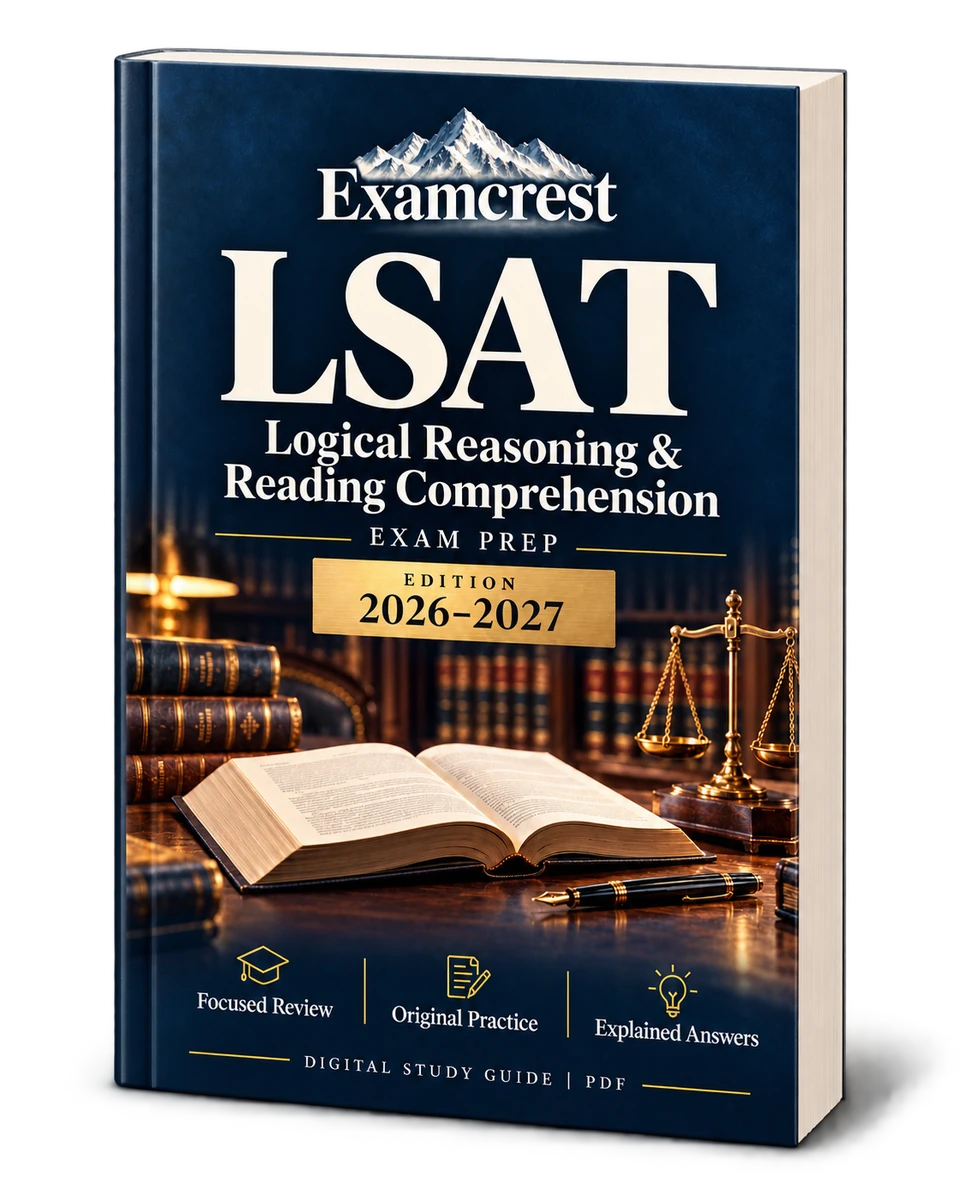
LSAT Logical Reasoning & Reading Comprehension Guide
Work on Logical Reasoning and Reading Comprehension with original instruction, practice activities, and explanations that distinguish support from assumption.
Focused study and practice. Check the coverage before you choose.

Study with a clear purpose
Separate the main conclusion, supporting reasons, and intermediate claims.
Work on assumptions, strengthen-and-weaken tasks, and precise flaws.
Check what the passage establishes before choosing a broader claim.
Your guide, at a glance
209 pages of foundation review, worked reasoning and explained practice in one downloadable PDF. 160 bank activities plus 85 lesson activities across 17 progressive units. Includes a two-page illustrated visual lesson.
Conclusions, premises, roles, methods, and disagreement.
Necessary and sufficient assumptions, strengthening, and weakening.
Flaws, inference, principles, conditional reasoning, and explanations.
Passage structure, author perspective, support, and comparison.
Explore two real pages from your guide
Included in your guide · LSAT-U11 · PDF pages 208–209
LSAT-U11 / Visual concept

Count events and distinct people separately.
L contains 50 letters from 10 writers; all 10 dispute letters come from one writer. M contains 100 letters from 10 other writers; each writer sends two dispute letters.
LSAT-U11 / Worked case

Letter share is 10/50 = 20% for L and 20/100 = 20% for M. Equal event shares do not establish equal participation.
L has 1/10 = 10% of writers with a dispute. M has 10/10 = 100%. Repeated letters do not create new people.
An anthology retains all 20 M disputes but only 20 other letters. Its 20/40 = 50% share differs from M’s complete 20% rate.
No. It restores equal complete letter rates, but writer breadth remains 10% versus 100%. These are different counted units.
Recorded letters do not establish every writer’s unrecorded opinion. Always identify the population, sampling rule and denominator before comparing proportions.
A practical study routine
Use the guide actively: make a decision before checking the answer, then bring the lesson into your next attempt.
Step 1
Identify what must be shown before looking at the options.
Step 2
Find the precise fact or assumption that decides the answer.
Step 3
Write why a tempting option overreaches or addresses a different question.
LSAT candidates seeking a focused reasoning companion to use alongside official LSAC practice.
The purchase includes this PDF edition. It does not include video lessons, tutoring, exam registration, or a promise of future updates. No exam result is guaranteed.
The funded-project example makes the rule and its reversal easy to tell apart. I like that the explanation also says what remains unknown, instead of quietly adding a conclusion the original condition doesn't support. That restraint makes the example useful for checking an answer that sounds plausible but goes beyond what the rule actually says.
The workshop argument gives the negation test a specific job. The walkthrough focuses on the missing link, making the idea of a necessary assumption easier to follow without confusing it with enough evidence for the whole conclusion.
The parallel-flaw explanation shows why finding another flawed argument isn't enough. Putting the arguments into the same structure makes the right match easier to justify than relying on similar wording or a familiar topic.
The invented legal opinions take some concentration. The new hypothetical gives their different reasons a purpose, so the comparison goes beyond noticing that both authors reached the same result in the original case.
The reconstruction passages are useful for tracking what each author supports and where the qualifications sit. I like having the relationship checked against both texts instead of reducing their positions to a quick agreement-or-disagreement label.
Before you decide
Choose the format and coverage that fit your study plan.
This is one English-language PDF download. No physical book is shipped. The page and practice counts shown above refer to the PDF included with this product.
The complete practice bank contains 160 numbered learning activities. Questions and teaching drills are counted as activities, not as full-length exams. The progressive lesson activities are separate from this bank count.
The product is delivered as a digital download associated with your order. Keep your order confirmation. If you have trouble locating or opening your file, contact ExamCrest with your order number.
Yes, with a compatible PDF reader. Save the file for offline reading. The book uses fixed pages, so smaller screens may require zooming; the sample pages show the layout before purchase.
The PDF supports printing. Choose the pages you need and check the scale and margins in your PDF reader. Printing costs and printer supplies are not included.
160 teaching activities for Logical Reasoning and Reading Comprehension. Multiple-selection and ordering drills support learning; they are not presented as official LSAT question formats. No full-length LSAT, LSAT Argumentative Writing course, or official score prediction is included. No passing result or score increase is guaranteed.
For download help or refund questions, contact ExamCrest using the support link below. Include the product name and, if you have purchased, your order number. Confirm any refund terms before ordering; no satisfaction-guarantee period is promised on this page.
LSAT Logical Reasoning & Reading Comprehension Guide
209 PDF pages · 160 complete bank activities · Answer explanations
One digital PDF. The contents and scope are shown above.