Follow the sentence’s logic
Use context and relationships to work through Text Completion and Sentence Equivalence.

Graduate admissions · Digital study guide
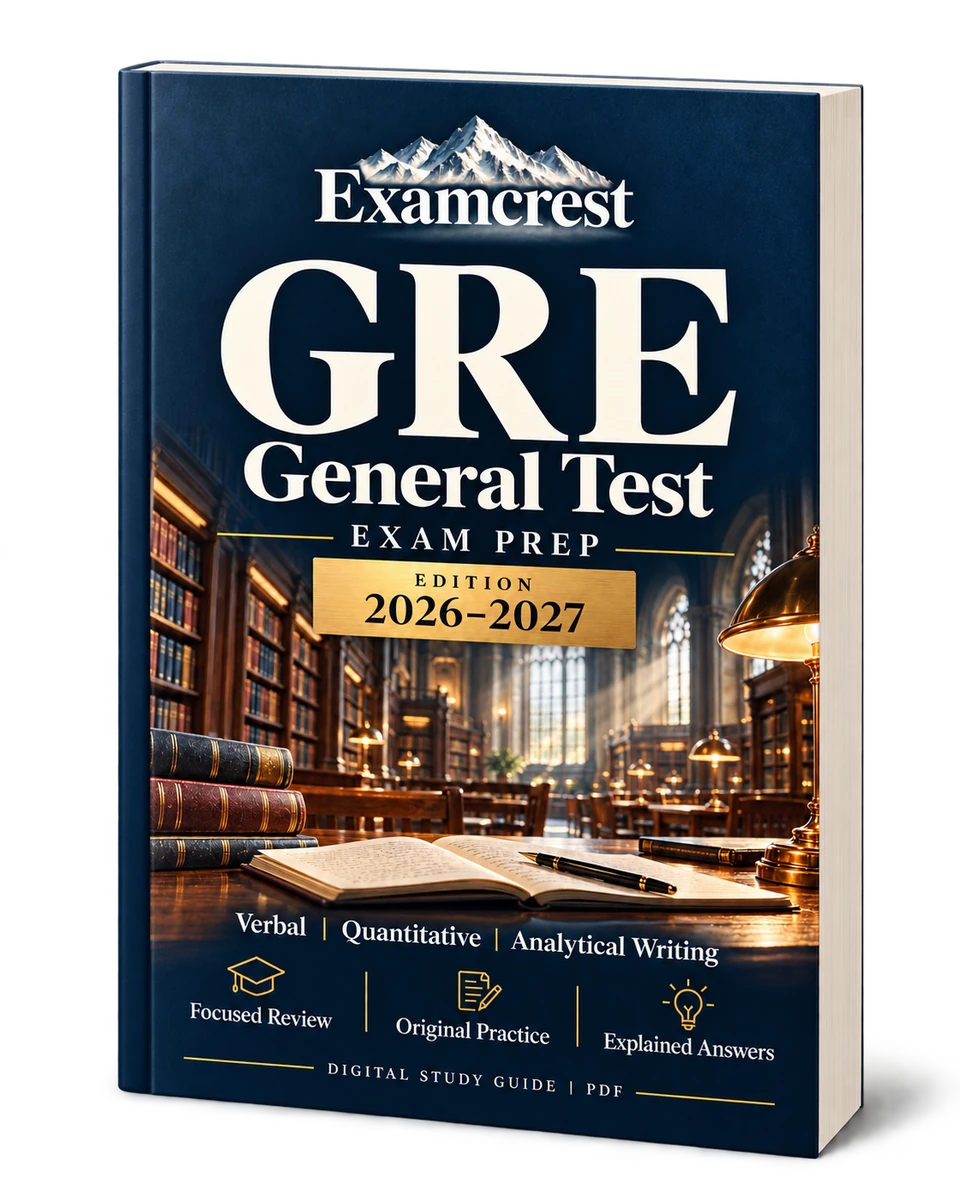
GRE General Test Study Guide
Bring verbal reasoning, quantitative work, and analytical writing into one organized study routine, with original tasks and explanations you can revisit at your own pace.
Focused study and practice. Check the coverage before you choose.

Study with a clear purpose
Use context and relationships to work through Text Completion and Sentence Equivalence.
Practice checking assumptions and counterexamples in Quantitative Comparison.
Use original writing prompts and response guidance to work on claims, reasons, and qualifications.
Your guide, at a glance
196 pages of foundation review, worked reasoning and explained practice in one downloadable PDF. 240 bank activities plus 80 lesson activities across 16 progressive units. Includes a two-page illustrated visual lesson.
Reading Comprehension, Text Completion, and Sentence Equivalence.
Arithmetic, number properties, algebra, geometry, and data.
Constraints, possible values, and whether a relationship is determined.
Analyze an Issue prompts, argument development, and self-review.
Explore two real pages from your guide
Included in your guide · GRE-U14 · PDF pages 195–196
GRE-U14 / Visual concept

Preserve the original domain and test every sign interval.
Solve (x - 2)/(x + 1) ≥ 1/2 over the real numbers. The original denominator excludes x = -1. Move everything to one side before deciding which intervals work.
GRE-U14 / Worked case

[(2(x - 2) - (x + 1))/(2(x + 1))] ≥ 0 becomes (x - 5)/(2(x + 1)) ≥ 0.
Below -1, both factors are negative. Between -1 and 5 the signs differ. Above 5 both are positive.
Include 5 because equality is allowed. Exclude -1 because the original expression is undefined. Solution: x < -1 or x ≥ 5.
The valid x < -1 interval can disappear. At x = -2, the original left side is 4; at x = 5 it equals 1/2.
Cancelling requires a nonzero denominator. Squaring can introduce candidates; inequality operations must preserve the relevant sign and original domain.
A practical study routine
Use the guide actively: make a decision before checking the answer, then bring the lesson into your next attempt.
Step 1
Identify whether the difficulty is vocabulary in context, a quantitative concept, or developing an argument.
Step 2
Solve or outline first, then compare with the explanation or writing guidance.
Step 3
Return to missed items and explain the principle without relying on a remembered answer.
Graduate school applicants who want a PDF companion for verbal, quantitative, and Analyze an Issue practice.
The purchase includes this PDF edition. It does not include video lessons, tutoring, exam registration, or a promise of future updates. No exam result is guaranteed.
The Quantitative Comparison example makes the value of a counterexample clear. I like that it tests different allowed values instead of letting one convenient calculation stand in for the whole problem. It gives the final choice a reason, while keeping the condition on the variable visible throughout the walkthrough.
The Sentence Equivalence example checks the meaning of both completed sentences. That's a helpful way to think about the task, especially when two answer choices look similar but don't really say the same thing.
The Issue-writing model keeps a clear position while taking a limitation seriously. The commentary shows how that exception can improve the argument, which is more useful than a general reminder to consider both sides.
The algebra walkthroughs are good at keeping the original restrictions visible. A tidy final calculation isn't the whole answer if it produces a value the starting expression doesn't actually allow.
The ordered-slot and unordered-selection examples make the difference between the two counting methods concrete. This is a section to work through on paper; the explanation makes the choice of method easier to justify.
Before you decide
Choose the format and coverage that fit your study plan.
This is one English-language PDF download. No physical book is shipped. The page and practice counts shown above refer to the PDF included with this product.
The complete practice bank contains 240 numbered learning activities. Questions and teaching drills are counted as activities, not as full-length exams. The progressive lesson activities are separate from this bank count.
The product is delivered as a digital download associated with your order. Keep your order confirmation. If you have trouble locating or opening your file, contact ExamCrest with your order number.
Yes, with a compatible PDF reader. Save the file for offline reading. The book uses fixed pages, so smaller screens may require zooming; the sample pages show the layout before purchase.
The PDF supports printing. Choose the pages you need and check the scale and margins in your PDF reader. Printing costs and printer supplies are not included.
The 240 practice activities include 48 writing prompts; they are not 240 multiple-choice questions. This static PDF does not reproduce adaptive delivery, automated essay scoring, or full-length official GRE practice. No passing result or score increase is guaranteed.
For download help or refund questions, contact ExamCrest using the support link below. Include the product name and, if you have purchased, your order number. Confirm any refund terms before ordering; no satisfaction-guarantee period is promised on this page.
GRE General Test Study Guide
196 PDF pages · 240 complete bank activities · Answer explanations
One digital PDF. The contents and scope are shown above.